
🧠 The New Way to Interview Prep
With LLMs and Active Recall

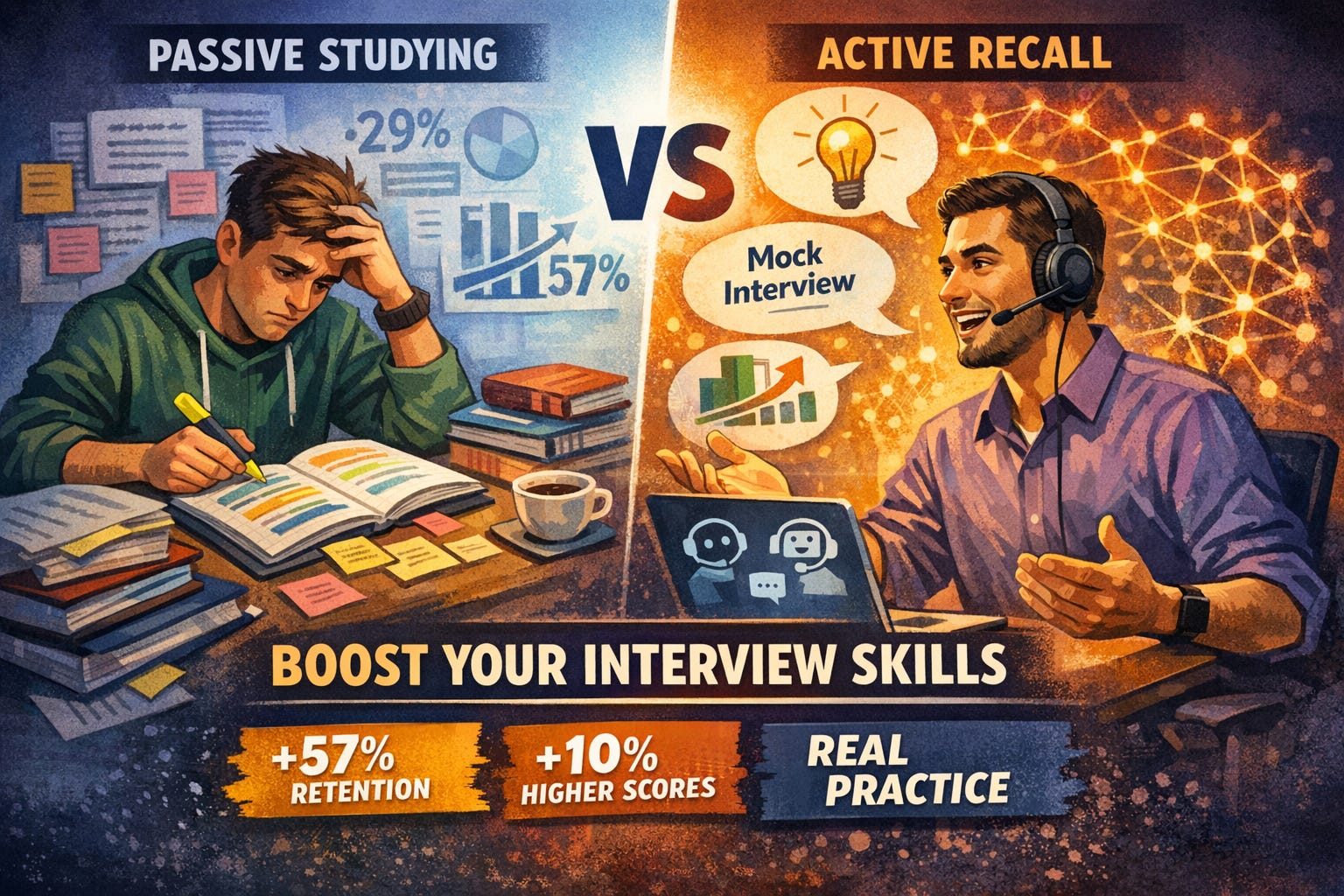
Most people prepare for interviews the same way they studied for exams: re-reading notes, highlighting bullet points, and hoping it sticks. The research says this is almost useless.
Cognitive science has consistently shown that active recall forcing your brain to retrieve information rather than passively review it produces dramatically better retention. One analysis found students using retrieval practice remembered 57% of material vs. just 29% for passive readers. Another found active recall techniques led to 10-12% higher test scores. The mechanism is simple: recognition tricks your brain into overconfidence. Retrieval actually builds the neural pathways you need under pressure.
Interviews are a retrieval task. You’re not reading your notes to your interviewer. You’re pulling structured stories and sharp thinking out of your head in real time. So why would you prep by reading?
Here’s what works instead 👇
Frontier models like Claude Opus 4.6 and ChatGPT 5.4 are remarkably good interview coaches. Feed one your target job description, public information about the product and company, and anything available about the hiring manager or team. Ask it to generate the questions you’re most likely to face behavioral, product sense, analytical, leadership.
Then switch to voice mode and answer each on the fly. Jam with AI. Tell it to act as a world class leadership coach. Then ask and to grade you on your strengths and weaknesses. It is not shy about giving you feedback. You can do this while taking a walk or sitting at your desk. Did you quantify impact? Were you concise? Iterate until it gives you an A-.
This is the critical shift: moving your prep from input (studying) to output (performing). You’re training the actual skill the interview demands.
Once you’ve done this for a dozen or so questions across key competency areas prioritization, leadership, cross-functional collaboration, ask the model to compile your best responses into a single document.
Now rigorously edit that doc. Tighten the language. Sharpen the results. Make sure every story has a clear situation, your specific actions, and a measurable outcome. Then practice aloud again, not reading, reciting from memory.
📌 For behavioral questions, aim for 60-90 seconds. No more. This is especially important for senior product leaders where conciseness signals executive presence. The hardest part is not getting across all the detail, it’s omitting all but the most essential signal.
Stop studying. Start answering. 🎯